When the DOJ released hundreds of thousands of pages of Jeffrey Epstein documents in clunky, unsearchable formats, a team of developers built something better in hours. JMail.world is now the de facto way to explore one of the most disturbing document dumps in American history.
On Friday, December 19, 2025, the Department of Justice finally released its trove of Jeffrey Epstein files — mandated by the Epstein Files Transparency Act that Congress passed with a staggering 427-1 vote. The release included over 3,500 files totaling roughly 3 gigabytes: photos, emails, flight logs, court documents, FBI interview transcripts, and evidence seized from Epstein’s properties.
There was just one problem: good luck actually searching any of it.
The DOJ’s “Epstein Library” at justice.gov/epstein came with a damning disclaimer: “Due to technical limitations and the format of certain materials… portions of these documents may not be electronically searchable.” Visitors encountered a queue system like they were buying concert tickets. Once inside, they found laggy interfaces, broken search functionality, and thousands of scanned PDFs that might as well have been written in hieroglyphics for all the good the search bar did.
Within hours, two San Francisco developers had fixed the problem entirely.

Enter JMail: Google Suite for a Monster
Riley Walz and Luke Igel didn’t set out to build the definitive Epstein research tool. They saw a design problem.
“The PDFs that the House Oversight Committee released were hard to read,” Igel told reporters. “We felt putting it in a familiar form with shareable links and easy to screenshot views would be helpful for people.”
Walz — previously described by the New York Times as a “local tech jester” for projects like the Panama Playlists (which exposed public figures’ Spotify listening habits) and a short-lived parking cop tracker — teamed up with Igel, CEO of AI video editing tool Kino, for what became their first real coding project together.
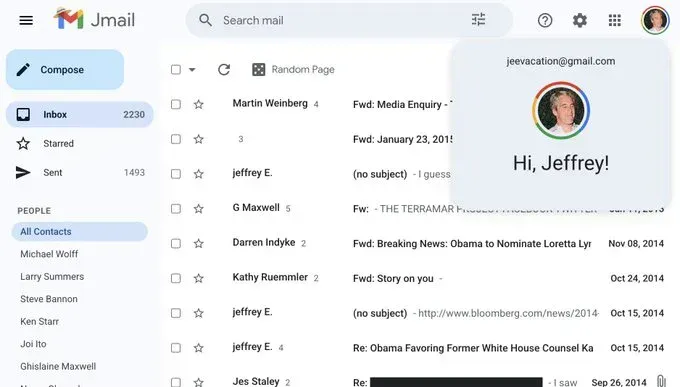
The original JMail launched in late November after the House Oversight Committee dropped 20,000 pages of Epstein estate documents. Using Google’s Gemini AI for optical character recognition, they extracted text from unsearchable PDFs and wrapped it all in something everyone already knows how to use: Gmail.
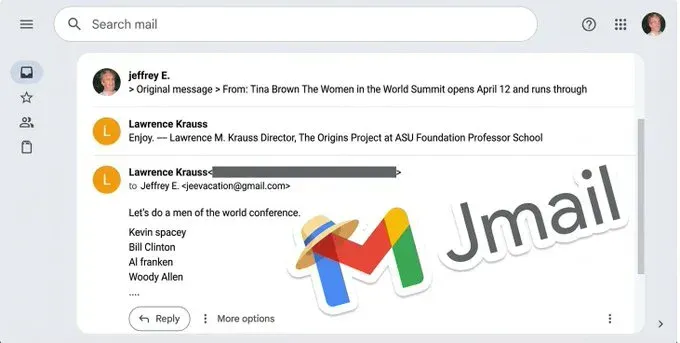
The result is genuinely unsettling. You’re greeted with “Hi, Jeffrey!” and logged into jeevacation@gmail.com — Epstein’s actual email address. His grinning profile photo sits in the top right corner. A tiny hat dangles from the Gmail logo. Every bit of UX design you’ve internalized from years of checking your own inbox now serves to navigate the communications of a convicted sex trafficker.
But it works. Type “Maxwell” or “Summers” or “Clinton” into the search bar and get instant results across thousands of emails. Click the starred folder to see what other users have flagged as significant — a crowdsourced editorial layer on top of the data. There’s even a “Random” button if you want to roll the dice on whatever correspondence awaits.
The December Explosion: JFlights, JPhotos, JDrive, and More
When the DOJ dropped its December 19 release, Walz and Igel were ready. They pulled an all-nighter with “a ton of friends” and launched an entire app suite designed to make the new files “grokable.”
The collaboration with Reducto.ai proved critical — their extraction tools turned scanned, blurry PDFs into structured JSON data that could actually be searched and displayed. What emerged was a dark mirror of Google’s entire productivity ecosystem:
JFlights: The Lolita Express Flight Tracker
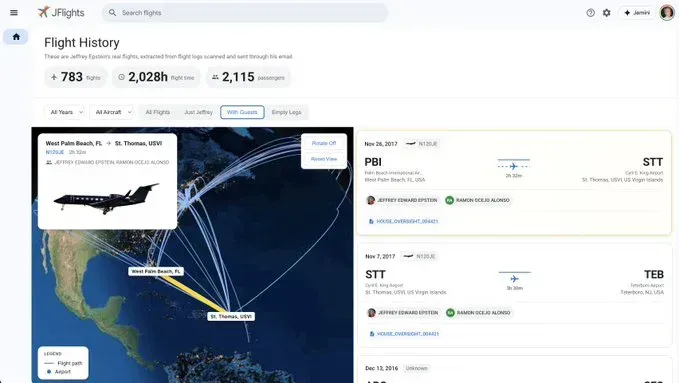
Imagine Google Flights, except every route involves a private jet registered to a pedophile.
JFlights catalogs a staggering 783 flights, 2,028 hours of flight time, and 2,115 total passengers extracted from flight logs. The interface is clean and professional — you’d think you were booking a trip to Denver until you notice the route is from West Palm Beach to St. Thomas, USVI, with passengers including “JEFFREY EDWARD EPSTEIN” and “RAMON OCEJO ALONSO” (Ghislaine Maxwell’s alias).
You can filter by aircraft (N212JE, N908JE — the infamous tail numbers), by year, or toggle between “Just Jeffrey” and flights with guests. Maps show the routes arcing across the Caribbean. Each entry links back to source documents.
JPhotos: His Camera Roll, Searchable
Google Photos for a man who should never have been allowed near a camera.
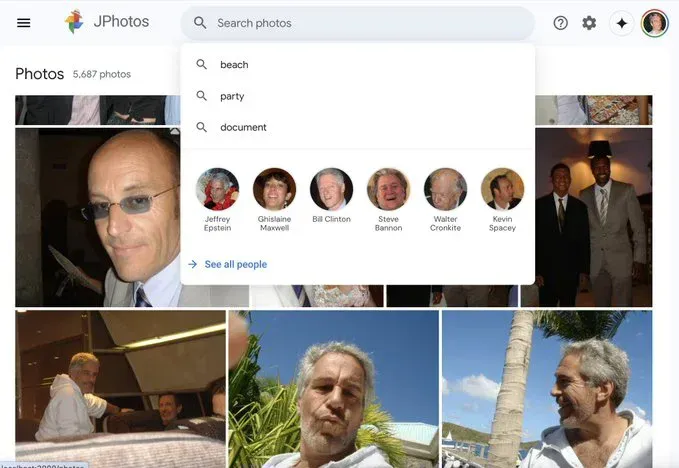
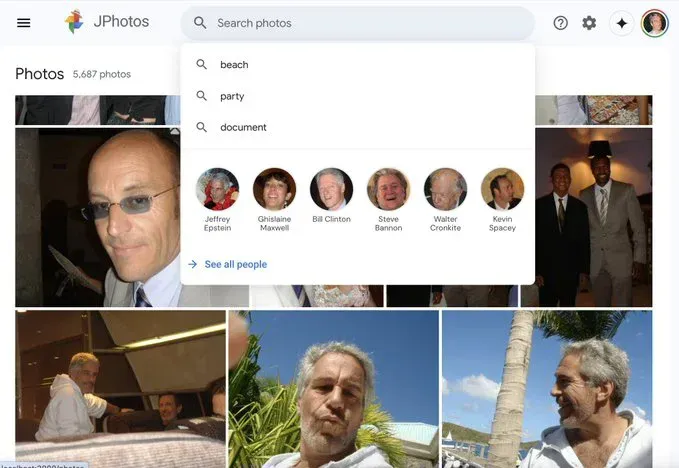
Over 5,687 photos from FBI seizures and DOJ releases, organized in a familiar thumbnail grid. Search by keyword: “beach,” “party,” “document.” Or browse by face — the interface offers quick filters for Jeffrey Epstein, Ghislaine Maxwell, Bill Clinton, Steve Bannon, Walter Cronkite, and Kevin Spacey.
The photos range from mansion interiors to evidence documents to disturbing images of Epstein with powerful people. Some faces are redacted. Many are not.
JDrive: Document Search That Actually Works
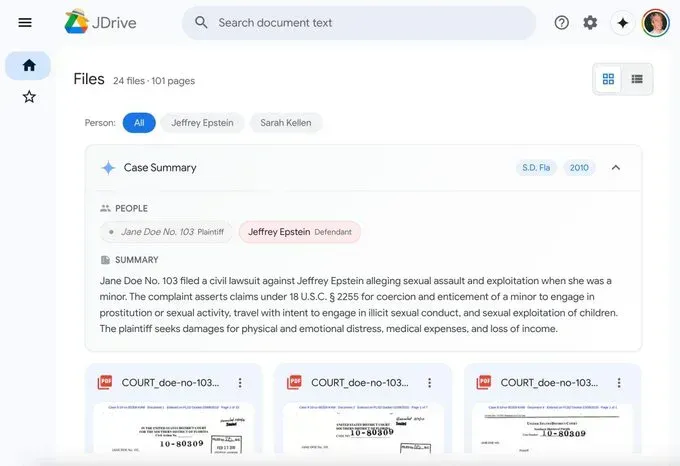
“We cloned Google Drive, except it’s Epstein’s files (and the search bar actually works… unlike the DOJ website).”
JDrive provides full-text search across the entire document corpus — 24 files totaling 101 pages in the initial release, with more being added continuously. Filter by person (“Jeffrey Epstein,” “Sarah Kellen”). Click into case summaries that provide structured metadata: case number, jurisdiction, year, parties involved, and plain-English descriptions of what each document contains.
One prominently featured case summary: “Jane Doe No. 103 filed a civil lawsuit against Jeffrey Epstein alleging sexual assault and exploitation when she was a minor. The complaint asserts claims under 18 U.S.C. § 2255 for coercion and enticement of a minor to engage in prostitution or sexual activity, travel with intent to engage in illicit sexual conduct, and sexual exploitation of children.”
JAmazon: What He Bought
Perhaps the most mundane and most disturbing tool of all.
JAmazon recreates Epstein’s Amazon order history, extracted from receipt emails. The interface looks exactly like checking your own purchase history — product images, order numbers, delivery dates, star ratings.
The orders include “The Annotated Lolita: Revised and Updated” delivered May 24, 2019 for $4.99.
He also bought a jasmine plant.
Jemini: AI-Powered Search Across Everything
The suite includes an AI assistant called Jemini (yes, like the Google product) that queries across all media in the database. Ask it anything. It’ll search emails, photos, documents, and flight logs to find relevant results.
This directly contradicts the DOJ’s claims that certain materials — like handwritten notes — were impossible to search “due to technical limitations.” Walz and Igel proved that a couple of developers with AI tools could do in hours what the federal government said couldn’t be done at all.
The Bigger Picture: What the Files Actually Contain
The JMail tools make it possible to understand what’s actually in this release — and what’s conspicuously missing.
What’s there:
- Previously unseen photos of Bill Clinton with Epstein and Ghislaine Maxwell, including images of Clinton in a hot tub and swimming in a pool with Maxwell- Photos of Michael Jackson standing next to Epstein in front of a painting of a naked woman- Mick Jagger seated between Epstein and Clinton at an event- Photos of Kevin Spacey with Epstein and unidentified men- An FBI complaint from September 1996 — nearly 30 years ago — alleging Epstein stole photos of 12 and 16-year-old girls and threatened to burn down the accuser’s house- Flight logs documenting thousands of trips- Emails between Epstein and figures like Noam Chomsky, Steve Bannon, Larry Summers, and journalist Michael Wolff
What’s redacted or missing:
- 119 pages of New York grand jury testimony — completely blacked out- At least 550 fully redacted pages- Names of alleged male perpetrators that victims’ lawyers say are in FBI possession- A draft indictment that Representative Ro Khanna says “implicates other rich and powerful men who knew about the abuse or participated in it”- A photo containing Donald Trump that was briefly removed from the DOJ website before being restored after public backlash
The FBI’s files reportedly contain over 300 gigabytes of data. The December 19 release totaled just 3 gigabytes.
The Political Firestorm
The release has ignited a bipartisan fury. Representative Ro Khanna, the Democrat who co-sponsored the transparency act, said the release “seems at very best incomplete” and is considering articles of impeachment against Attorney General Pam Bondi. His Republican co-sponsor, Representative Thomas Massie, suggested Bondi could face obstruction of justice charges.
Senator Chuck Schumer called the release “a mountain of blacked out pages” that “violates the spirit of transparency and the letter of the law.”
The DOJ removed at least 16 files from its website over the weekend, including one containing photos of Trump. After backlash, Deputy Attorney General Todd Blanche said the image was pulled due to concerns about potential victims in the photo — not because of the president — and it was eventually restored.
Meanwhile, President Trump has directed the DOJ to investigate Democrats mentioned in the files, specifically naming Bill Clinton, Larry Summers, Reid Hoffman, and JP Morgan.
Why This Matters Beyond the Names
The JMail project demonstrates something profound about information access in 2025.
When the government releases documents in deliberately obtuse formats — laggy websites, unsearchable PDFs, broken interfaces — it creates the illusion of transparency while maintaining effective opacity. The information is technically public. It’s just practically impossible to navigate.
“I think other people should do similar things where you think that just a little bit of new software can make a lot of these things that are happening in the world easier to understand,” Igel said. “You should just do it.”
The tools keep expanding. Developer Pat Dennis released a facial recognition search that scans the files for specific individuals — open source on GitHub. He’s already expanded it to search January 6th photos from Sedition Hunters. Advait Paliwal built an Apple Music clone to play grand jury transcripts. Diego from Krea AI created EpsteinVR — a full 3D walkthrough of Epstein’s mansion using AI-generated Gaussian splat models.
All of it coming soon to the JMail suite.
The Uncomfortable Reality
There’s something deeply uncomfortable about making a dead pedophile’s life this accessible. The Gmail interface feels wrong — an uncanny valley of familiarity applied to horror. You know how to use it because you’ve used Gmail for years. That’s what makes it effective. That’s what makes it disturbing.
But the alternative is worse: documents released to technically comply with the law while remaining effectively hidden. A government that claims “technical limitations” prevent searchability while private citizens prove otherwise in a single night of coding.
The Epstein files are public now. The question was never whether we could see them. It was whether we could understand them.
JMail made sure we can.
The Tools:
- JMail (Email): jmail.world- JFlights: jmail.world/flights- JPhotos: jmail.world/photos- JDrive: jmail.world/drive- JAmazon: jmail.world/jamazon- About/Credits: jmail.world/about
Created by Luke Igel (CEO, Kino AI) and Riley Walz, with document processing by Reducto.ai.