
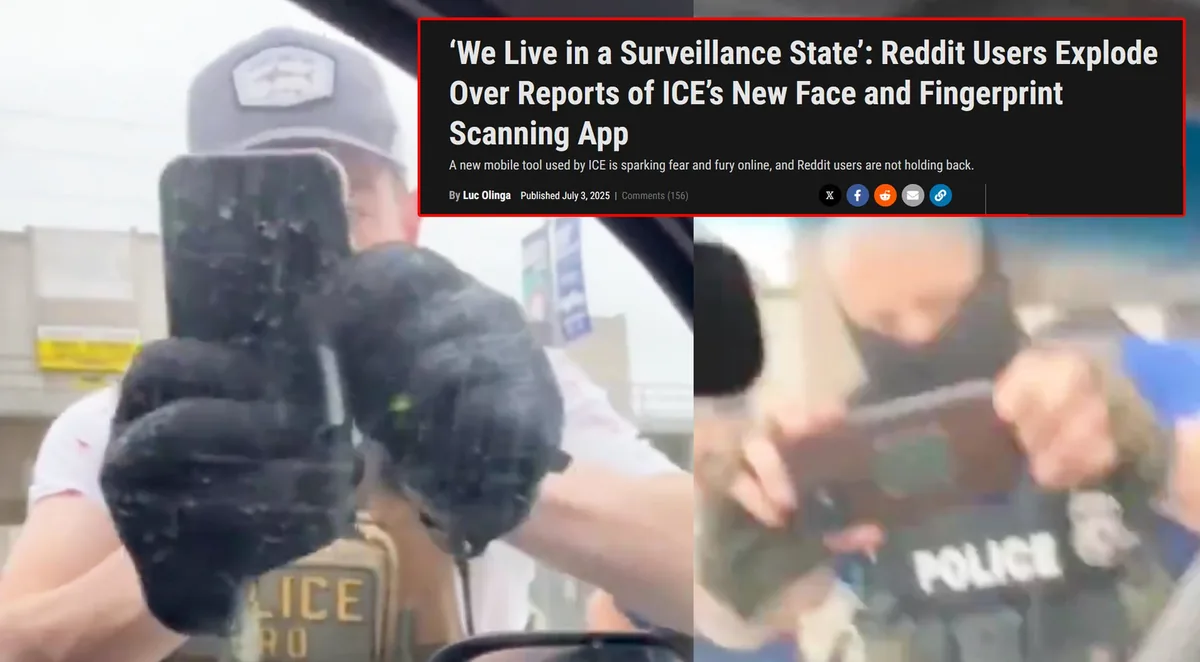
ICE has deployed a new smartphone application called “Mobile Fortify” that allows agents to identify individuals using facial recognition and contactless fingerprints by simply pointing their government-issued phone cameras at people. This represents a significant expansion of surveillance capabilities from traditional border checkpoints into domestic field operations.
Smart Cities and Privacy: The Double-Edged Sword
How the App Works
The app “empowers users with real-time biometric identity verification capabilities utilizing contactless fingerprints and facial images captured by the camera on an ICE issued cell phone without a secondary collection device”. The technology uses the CBP system which ordinarily takes photos of people when they enter or exit the U.S., but now ICE is using it in the field domestically.
Database Connections
Mobile Fortify connects to several powerful databases:
- CBP’s Traveler Verification Service (TVS) and the Automated Biometric Identification System (IDENT), which holds records on more than 270 million individuals- The Seizure and Apprehension Workflow, described by DHS as an “intelligence aggregator” that brings together information related to searches and seizures- Databases like IDENT and its eventual successor, the Homeland Advanced Recognition Technology (HART) platform, now store not only fingerprints and facial images, but also iris and gait patterns
Palantir Connection
While Mobile Fortify itself isn’t directly built by Palantir, there are significant connections through ICE’s broader surveillance infrastructure:
ImmigrationOS Contract: ICE is paying Palantir $30 million to create what it’s calling the Immigration Lifecycle Operating System, or ImmigrationOS, to help ICE decide who to target for deportation, as well as offering “near real-time visibility” into self-deportations.
Integrated Systems: ImmigrationOS is built directly on top of the existing ICM infrastructure and these databases are interwoven with systems such as the Enforcement Integrated Database and Palantir’s analytics platforms, creating a networked surveillance ecosystem.
Location Tracking: Internal Palantir communications show the company is helping find the location of people flagged for deportation, that Palantir is now a “more mature partner to ICE,” and how Palantir is addressing employee concerns with discussion groups on ethics.
Privacy and Civil Rights Concerns
Civil liberties advocates have raised serious concerns:
Accuracy Issues: Nathan Freed Wessler, deputy director of the American Civil Liberties Union’s Speech, Privacy, and Technology Project, expressed concern over the reliability of such systems: “Face recognition technology is notoriously unreliable, frequently generating false matches and resulting in a number of known wrongful arrests across the country”.
Constitutional Questions: “Congress has never authorized DHS to use face recognition technology in this way, and the agency should shut this dangerous experiment down,” Wessler said.
Scope of Surveillance: This level of portability and automation suggests a capability that is poised to extend biometric surveillance far beyond designated checkpoints and into neighborhoods, local transport hubs, and any environment in which ICE officers operate.
Other Surveillance Partnerships
ICE’s surveillance ecosystem extends beyond Palantir:
- At least $3,614,000 worth of contracts between the agency and Clearview, a facial recognition platform, to provide software that may reveal a person’s name and social media profiles- ICE agents have gained access to a nationwide database of automatic license plate readers provided by Flock Safety, despite having no formal contract with the company
Leaked emails indicate that ICE is now using ‘Mobile Fortify,’ a facial recognition tool that lets agents ID anyone just by pointing a smartphone camera at them.
It may start with “illegal immigrants” — but make no mistake, this technology will be used against you next. pic.twitter.com/f3fVFjNhcG— Jason Bassler (@JasonBassler1) July 7, 2025
Bottom Line
The Mobile Fortify app represents a significant escalation in ICE’s surveillance capabilities, bringing border-style biometric identification into domestic enforcement. While not directly built by Palantir, it operates within a broader surveillance ecosystem that heavily involves Palantir’s data analytics and tracking systems. The expansion of the surveillance state raises civil liberty concerns, not just for migrants, but for all Americans, as facial recognition technology can misidentify individuals and lacks comprehensive legal oversight at the federal level.
This development reflects the Trump administration’s broader push to leverage advanced technology for immigration enforcement, raising fundamental questions about privacy, due process, and the extent of government surveillance in American communities.