
TL;DR: In 2013, Congress quietly repealed a 64-year ban that prevented the U.S. government from using propaganda on American citizens. Rep. Thomas Massie recently tried to restore these protections, but House Speaker Mike Johnson blocked the vote. Here’s what this means for your privacy and information freedom.
The Trojan Horse: How Propaganda Became Legal Again
For over six decades, American citizens enjoyed a critical protection most never knew existed. The Smith-Mundt Act of 1948 included a domestic dissemination ban that prevented U.S. government agencies from targeting American audiences with propaganda materials created for foreign consumption. This firewall between foreign information operations and domestic audiences was a cornerstone of democratic information integrity.
But in January 2013, that protection vanished.
What Was the Smith-Mundt Act?
The original Smith-Mundt Act of 1948 emerged from the ashes of World War II as America entered the Cold War. Named after Rep. Karl Mundt (R-SD) and Sen. H. Alexander Smith (R-NJ), the legislation formalized America’s international information programs, including Voice of America and Radio Free Europe. These programs were designed to counter Soviet propaganda abroad and promote American values internationally.
Crucially, the Act included three key restrictions:
- Domestic dissemination ban: Government-produced foreign propaganda could not be distributed within the United States2. Private sector priority: The government couldn’t monopolize information channels and had to defer to private media when adequate3. Transparency requirements: Clear attribution and oversight mechanisms
The domestic ban wasn’t an afterthought—it was a deliberate safeguard. As Sen. Edward Zorinsky (D-NE) argued in 1985, allowing domestic distribution would make U.S. information agencies “no different than an organ of Soviet propaganda.”
The 2013 “Modernization”: A Propaganda Green Light
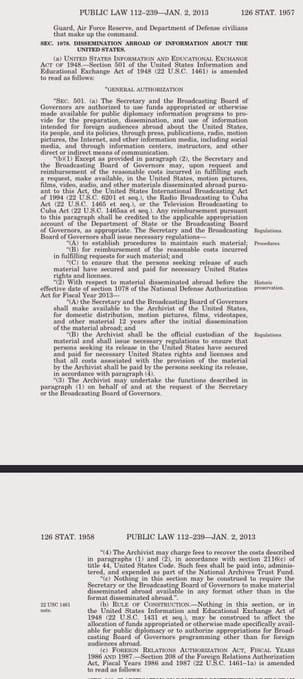
The Smith-Mundt Modernization Act of 2012, embedded as Section 1078 of the National Defense Authorization Act (NDAA) for Fiscal Year 2013, fundamentally changed this landscape. Sponsored by Rep. Mac Thornberry (R-TX) and Rep. Adam Smith (D-WA), the legislation passed with minimal debate and went into effect on July 2, 2013.
What changed?
The 2013 amendment allows the State Department and Broadcasting Board of Governors to:
- Make government-produced content available to domestic audiences “upon request”- Distribute materials originally created for foreign audiences within the United States- Engage in information activities regardless of whether domestic audiences might be exposed
The official justification focused on “transparency” and countering anti-American sentiment online. Proponents argued that in the digital age, these materials were already accessible via the internet, so legal restrictions were obsolete.
The Privacy and Democratic Implications
Information Warfare Comes Home
The repeal represents more than a technical legal change—it’s a fundamental shift in the relationship between government and citizen. Here’s why privacy advocates should be concerned:
1. Covert Influence Operations Without attribution requirements, government-produced content can infiltrate domestic information streams without clear identification. Citizens may unknowingly consume taxpayer-funded propaganda designed to shape public opinion.
2. Psychological Manipulation Techniques The legislation enables the use of sophisticated influence techniques developed for foreign audiences—including “nudge theory” and behavioral psychology—against American citizens. These methods can manipulate decision-making processes without conscious awareness.
3. Erosion of Information Sovereignty The government now positions itself as an “interested party” in domestic political debates, using the same tools and techniques employed against foreign adversaries. This fundamentally alters the democratic principle that citizens should form opinions through free and open discourse.
4. Resource Diversion Concerns As originally intended by the Smith-Mundt Act, resources meant for international operations may be diverted to domestic influence campaigns, essentially forcing taxpayers to fund their own manipulation.
The Wikipedia Problem
Recent research reveals how the 2013 changes have compromised information integrity in unexpected ways. Government-funded content now appears in sources like Wikipedia without clear attribution, making it difficult for users to distinguish between independent journalism and government narratives. This “propaganda laundering” affects the reliability of information sources Americans trust daily.
Comparing the Espionage Act, NDAA, and Whistleblower Protection Act
Thomas Massie’s Blocked Amendment: Democracy Denied
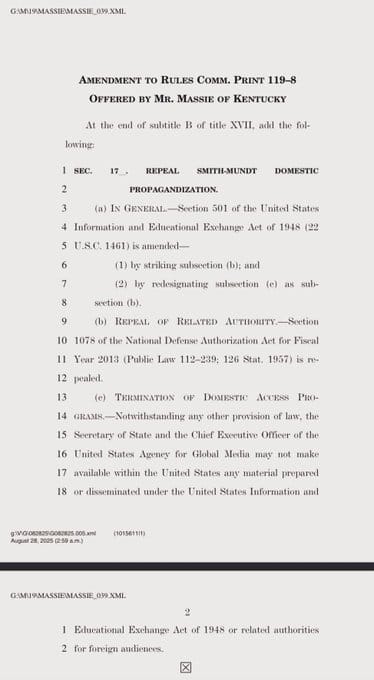
Rep. Thomas Massie (R-KY), a longtime critic of expansive government power, recently attempted to restore the original Smith-Mundt protections. According to his social media statement, Massie offered an amendment to reinstate the prohibition against domestic propaganda, but House Speaker Mike Johnson blocked the vote.
The Smith-Mundt Modernization Act (part of 2013 NDAA) repealed the prohibition that kept the U.S. government from using propaganda on U.S. citizens.
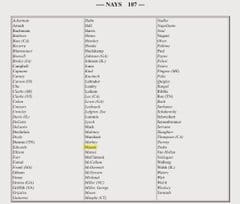
I voted against that NDAA.
Recently, I offered an Amendment to reinstate the prohibition, but @SpeakerJohnson blocked the vote. pic.twitter.com/WlecyVgUsP— Thomas Massie (@RepThomasMassie) September 14, 2025
Massie’s Track Record
Massie’s opposition to the NDAA isn’t new. He voted against the 2013 NDAA that contained the Smith-Mundt repeal, demonstrating consistent concern about government overreach. His libertarian-leaning principles have made him a persistent voice for limited government and individual liberties.
Why Was the Vote Blocked?
While the specific reasons for Speaker Johnson’s decision aren’t publicly detailed, the blocking of Massie’s amendment prevents Congress from reconsidering a law that fundamentally altered American information policy with minimal public debate. This procedural move denies both representatives and the public the opportunity to address growing concerns about domestic propaganda.
The Broader Pattern
Massie’s blocked amendment reflects a broader pattern of leadership resistance to transparency and oversight measures. As someone who has consistently challenged both parties when they expand government power, Massie’s isolation on this issue highlights how bipartisan the pro-propaganda consensus has become.
Real-World Impact: How This Affects You
Information Environment Pollution
The 2013 changes contribute to what experts call “information pollution”—the contamination of the information environment with materials designed to influence rather than inform. This affects:
- News consumption: Government-produced content may appear in trusted news sources without clear labeling- Social media: Sophisticated influence campaigns can shape online discourse- Educational materials: Taxpayer-funded content with embedded messaging may reach schools and universities- Community information: Local news outlets may unwittingly republish government-produced materials
The Privacy Dilemma: Data Brokers, Cambridge Analytica, and Photo Metadata Exploitation
Privacy Implications
Beyond information integrity, the repeal creates privacy concerns:
- Behavioral tracking: Government agencies can now legally collect data on how domestic audiences respond to their content- Psychological profiling: Techniques developed for foreign influence operations can be applied to American citizens- Data sharing: Information gathered from domestic propaganda operations may be shared across government agencies
International Perspective: What Other Countries Think
The irony of America’s propaganda legalization hasn’t been lost on international observers. While the U.S. criticizes authoritarian regimes for domestic propaganda operations, it has quietly adopted similar capabilities. Countries like Russia and China now point to the Smith-Mundt repeal when defending their own information operations.
This undermines America’s credibility in promoting free press and information integrity globally, potentially weakening international cooperation against actual foreign propaganda efforts.
The Path Forward: Restoring Information Integrity
Legislative Solutions
Several approaches could restore protections while addressing legitimate modernization needs:
1. Attribution Requirements Mandate clear, prominent labeling of all government-produced content distributed domestically, similar to requirements for political advertisements.
2. Sunset Clauses Implement automatic expiration dates for domestic information programs, requiring regular Congressional review and reauthorization.
3. Transparency Reporting Require annual public reports detailing domestic information activities, budgets, and distribution methods.
4. Independent Oversight Establish an independent board to monitor compliance and investigate potential abuses.
Supporting Massie’s Efforts
Citizens concerned about information integrity can:
- Contact representatives to support future Smith-Mundt restoration efforts- Demand transparency in government information programs- Support independent journalism and media literacy initiatives- Advocate for clear attribution requirements
Media Literacy and Personal Protection
While systemic reform is essential, individuals can protect themselves by:
- Source verification: Always check the original source of information- Attribution awareness: Look for clear authorship and funding information- Cross-referencing: Compare information across multiple independent sources- Critical thinking: Question information that seems designed to influence rather than inform
🎧 Related Podcast Episode
Conclusion: The Stakes for Democracy
The quiet repeal of Smith-Mundt’s domestic dissemination ban represents one of the most significant changes to American information policy in decades. Yet it occurred with minimal public awareness or debate. Thomas Massie’s blocked amendment highlights how difficult it has become to reverse this expansion of government power.
The stakes extend beyond partisan politics. The ability of government to legally influence domestic public opinion using sophisticated propaganda techniques fundamentally alters the relationship between citizen and state. It transforms the government from a servant of the people into a potential manipulator of public consciousness.
Restoring Smith-Mundt protections isn’t about partisan advantage—it’s about preserving the democratic principle that citizens should form opinions through free and open discourse, not through sophisticated government influence operations.
The next time you consume news, consider: Are you reading independent journalism, or taxpayer-funded propaganda designed to shape your thinking? In post-2013 America, it’s often impossible to tell the difference. That’s precisely why the original Smith-Mundt protections existed—and why Thomas Massie’s fight to restore them matters for every American who values information freedom and democratic governance.
This article is based on publicly available legislative records, academic research, and news reports. For the latest developments on Smith-Mundt reform efforts, follow Rep. Massie’s official communications and Congressional proceedings.