
Microsoft’s implementation of mandatory age verification for Xbox users in the UK marks a concerning shift toward increased surveillance and control over digital spaces.
The Changes Coming to Xbox
Xbox users in the UK who indicate their account age as 18 and over are now being encouraged to verify their age as part of Microsoft’s compliance with the UK Online Safety Act. Starting early in 2026, those who don’t complete this verification will lose access to most social features including voice chat, text communication, game invites, and user-generated content.
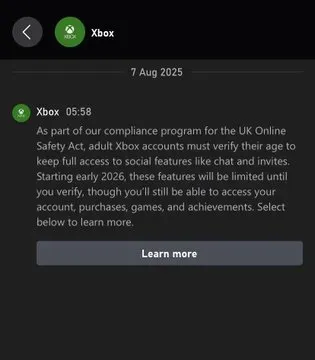
 The verification process requires users to provide:
- Government-issued ID (driver’s license or passport)- Facial recognition scans- Credit card verification- Mobile phone verification
Players who don’t verify their age can continue playing games and making purchases, but their social interactions will be severely limited to friends-only communication.
The UK Online Safety Act: A Censorship Framework
The UK’s Online Safety Act, which went into full effect on July 25, 2025, requires platforms to use “highly effective age assurance” to prevent children from accessing adult content, including content that encourages self-harm, suicide, or eating disorders. While framed as child protection, critics argue the legislation creates a comprehensive surveillance and censorship infrastructure.
The Electronic Frontier Foundation has condemned the Online Safety Bill as “a massive threat to online privacy, security, and speech,” warning that it “will lead to a much more censored, locked-down internet for British users”.
Privacy and Surveillance Concerns
The End of Anonymous Browsing
Free speech advocates warn that age verification systems essentially condemn users “to a future of relentless scrutiny and self-censorship” by connecting online presence with real identity. The requirement forces users to sacrifice anonymity—a cornerstone of free expression online.
Data Collection and Security Risks
Age verification systems require the collection of sensitive biometric and identity data. Critics describe these verification tools as “a ticking timebomb as it is a matter of when, not if, such information finds its way into criminal hands”.
Government Surveillance Infrastructure
Privacy experts argue that age verification is part of an incremental approach to end online anonymity, with intelligence agencies exploiting child protection narratives to regain surveillance capabilities in the online era. The system creates infrastructure that could easily be expanded for broader monitoring purposes.
The Ineffectiveness Problem
Despite the privacy trade-offs, early evidence suggests these systems are easily circumvented. Users have already found ways to bypass age verification on platforms like Reddit and Discord by using the character creation features in video games like Death Stranding, highlighting how the system “isn’t a very robust system”.
The Electronic Frontier Foundation argues that “the UK’s scramble to find an effective age verification method shows us that there isn’t one” and that the system fails to make children safer while restricting everyone’s rights.
Global Implications
Microsoft has made clear this won’t stop with the UK. The company expects “to roll out age verification processes to more regions in the future,” though “these methods may look different across regions and experiences”.
Similar legislation is being considered or implemented across:
- Europe: The Digital Services Act is being used to enforce stricter age protections- United States: The Kids Online Safety Act shares goals with the UK’s law- Australia, France, Italy, and Canada: Have introduced various ID verification systems
The Broader Pattern of Digital Control
Corporate Censorship Outsourcing
The Online Safety Act “outsources censorship to corporations” and “incentivises over-removal” as platforms face fines of up to 10% of global turnover for non-compliance. This creates a system where private companies become the arbiters of acceptable speech to avoid regulatory penalties.
Algorithmic Moderation Problems
The scale of content requiring moderation means companies “will inevitably turn to AI moderation systems to comply with the Act. But such systems are notoriously imprecise, flagging satire, contextually appropriate material, or even legal speech as harmful or illegal”.
Unaccountable Regulatory Power
Ofcom, “an organisation entirely outside democratic accountability, is now both rule-maker and enforcer, with discretion to define what ‘compliance’ means in practice”, giving an unelected body significant control over online speech.
Public Resistance
The UK public has shown strong opposition to these measures. Within days of age checks coming into effect, VPN apps became the most downloaded on Apple’s App Store in the UK, and a petition calling for the repeal of the Online Safety Act hit more than 400,000 signatures.
What This Means for Digital Rights
The Xbox age verification requirement represents more than just a gaming platform policy change—it’s part of a broader shift toward:
- Normalized Surveillance: Making identity verification a standard requirement for online participation2. Erosion of Anonymous Speech: Eliminating spaces for private expression and whistleblowing3. Corporate Control of Communication: Giving private companies unprecedented power over human interaction4. Global Precedent Setting: Creating a model that other nations will likely adopt
The Path Forward
As Index on Censorship warns, age verification “opens up too many avenues for increased surveillance and monitoring, all of which fosters an environment of self-censorship, stifles open dialogue and erodes the right to free expression and access to information”.
The implementation of age verification on Xbox—a platform primarily used for entertainment—demonstrates how quickly “child protection” measures can expand to cover virtually all online activity. Young people deserve to “access information, speak to each other and to the world, play games, and express themselves online without the government making decisions about what speech is permissible”.
Rather than accepting this digital surveillance infrastructure as inevitable, users, advocates, and policymakers must recognize that effective child protection doesn’t require sacrificing fundamental rights to privacy and free expression for everyone.
The choice facing us is clear: Will we allow the gradual erosion of digital freedoms in the name of safety, or will we demand solutions that protect children without surveilling adults? Xbox’s age verification requirement may seem like a minor gaming policy, but it represents a significant step toward a future where anonymous, private communication becomes impossible.
The time to resist this surveillance infrastructure is now, before it becomes so normalized that we forget what digital freedom looked like.